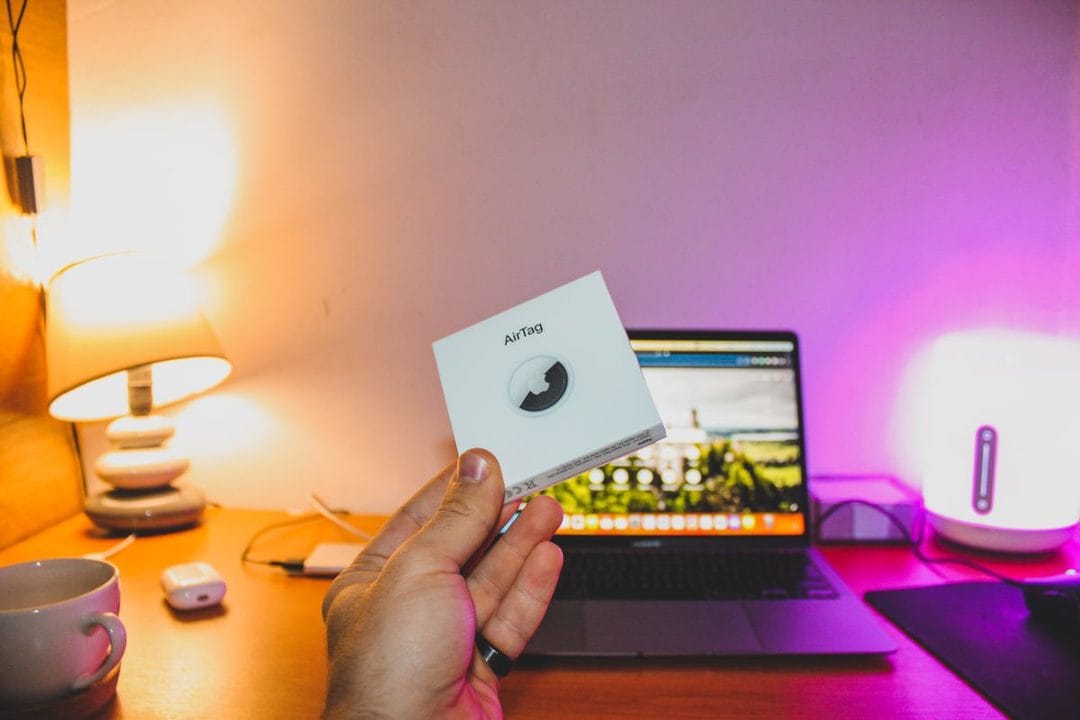
You watched the carousel spit out every bag but yours at Denver International last month, and the airline app just kept saying "in transit" for eleven straight hours with no city, no gate, no explanation. If a two-inch plastic disc had been zipped inside that suitcase, you'd have known within minutes it was sitting on a cart in Atlanta, not lost, not stolen, just misrouted. That's the entire pitch behind Bluetooth item trackers in 2026: Apple's AirTag, Tile's lineup, and Samsung's Galaxy SmartTag2 all promise the same peace of mind, but they get there through different networks, different phones, and prices that swing by $15 depending on which one you grab off the shelf at Target.
How These Tiny Trackers Actually Find Anything
None of these devices has GPS inside, and that's the part most buyers assume incorrectly before their first purchase. A real-time GPS chip needs a cellular radio, a data plan, and a battery the size of a deck of cards, and none of that fits inside something you clip to a keyring for $29. Instead, each tracker broadcasts a quiet, encrypted Bluetooth signal that any nearby device belonging to the same network can pick up and relay anonymously to a server, without that stranger's phone owner ever knowing it happened. Apple's version, called the Find My network, leans on more than a billion active iPhones, iPads, and Macs worldwide, which is why an AirTag left in a rideshare in a random city still tends to report a location within an hour. Samsung's SmartThings Find network runs the same trick through hundreds of millions of Galaxy phones, strongest in exactly the places you'd expect: dense US metros with heavy Samsung market share. Tile takes a different, smaller path — its own app's user base plus a partnership that piggybacks on Amazon's Sidewalk mesh, which uses select Echo speakers and Ring cameras as relay points. The catch nobody mentions in the ads is coverage density: a tracker is only as useful as the number of strangers' devices walking past it, so a AirTag lost in a rural stretch of Montana and a Tile lost in the same spot behave very differently.
AirTag vs. Tile vs. Galaxy SmartTag2: What You're Really Paying For
Apple's AirTag runs $29 for one or $99 for a four-pack, uses a replaceable CR2032 coin battery rated for about a year, and includes a small speaker for the "play sound" feature. On iPhone 11 and later, it also unlocks Precision Finding — an on-screen arrow and distance readout powered by the U1 Ultra Wideband chip, which is genuinely useful when you're standing in a cluttered garage trying to figure out which coat pocket has your keys. Tile's lineup is more fragmented: the Mate runs $24.99, the Pro is $34.99 with roughly 400 feet of range and a noticeably louder speaker, the Slim is $29.99 and thin enough to sit flat in a wallet, and the waterproof Sticker is $29.99 for things like a bike frame or a TV remote. Samsung's Galaxy SmartTag2 costs $29.99, adds an IP67 water and dust rating that neither AirTag nor most Tiles match, and Samsung claims roughly 500 days of battery life in standard mode — closer to 700 in the low-power "compact" setting that trades ring-finding volume for longevity. That battery gap alone should settle a lot of buying decisions before price does.
Battery Life Nobody Talks About Until It's Dead
Buy the CR2032-based version if you hate subscriptions and don't mind a five-minute swap once a year. Skip the rechargeable Tile Pro unless you're genuinely willing to plug it in every few months, because a dead rechargeable tracker is worse than no tracker at all — it just sits there silently failing while you assume it's working.
The iPhone vs. Android Question That Decides Everything
This is the one factor that should override brand loyalty and even price. An AirTag paired to an iPhone works exactly as advertised, but an Android user setting up an AirTag is stuck with almost nothing — no dedicated app to view live location, no Precision Finding, just an occasional "Tracker Detect" scan that only tells you an unfamiliar AirTag is nearby, which exists purely for anti-stalking purposes rather than everyday use. Tile, by contrast, runs an identical app experience on both platforms, which makes it the obvious pick for mixed households or anyone who splits time between an iPhone at work and a personal Android phone. Samsung's SmartTag2 technically works through the SmartThings app on any Android phone, but the crowdsourced network it depends on is overwhelmingly made up of other Galaxy devices, so tracking accuracy drops noticeably once you're outside a Samsung-heavy area — and it offers effectively nothing to an iPhone owner. If your entire household carries iPhones, the AirTag decision makes itself. If it's a mixed bag of devices, Tile is the only one of the three that doesn't ask half the family to sit out.
Anti-Stalking Protections Have Actually Gotten Better
Early AirTag coverage in 2022 focused almost entirely on stalking risks, and the criticism was fair — an AirTag slipped into a coat pocket or a car bumper could track someone for days before they noticed. Apple and Google jointly rolled out a cross-platform detection standard in 2024 that Android phones now use natively, alerting users when an unfamiliar Find My-network accessory has been traveling with them for an extended period, regardless of whether they own an iPhone. Samsung ships its own version through SmartThings called Unknown Tag Alerts, and most third-party trackers, including current Tile models, have adopted similar detection logic under the same industry framework. Tapping an unwanted tracker against an NFC-capable phone reveals a partial serial number and a direct path to disable it, which is a real improvement over the scavenger hunt this used to require. None of this makes covert tracking impossible — a determined stalker can still disable alerts by removing the speaker or wrapping the tracker to block Bluetooth — but the gap between "theoretically detectable" and "detected before real harm" has closed considerably since 2022.
What to Actually Buy One For (and What to Skip)
Keys and a wallet are the easy calls. Any of the three works fine for keys, though the Tile Slim's credit-card shape genuinely disappears into a wallet in a way the boxier AirTag never quite does. Luggage is where network size matters most, since a bag stuck at a distant airport is exactly the scenario where you need the biggest possible pool of strangers' phones walking past it — which makes the AirTag the strongest pick for international travel, with Apple's device count simply outnumbering Samsung's and Tile's combined in most countries outside South Korea.
Bikes and pets are where this technology quietly stops making sense, no matter how the marketing photos suggest otherwise. Bluetooth range tops out around 100–400 feet even in ideal conditions, and these trackers rely entirely on someone else's phone walking within that range and relaying the location — useless if a stolen bike gets loaded into a truck and driven twenty miles before the next relay point. A pet that slips out the backyard gate and heads into a wooded area with no foot traffic will similarly vanish from the map the moment it's outside Bluetooth range of any network device, and there's no fallback signal to catch up once that happens. For a bike, a cable lock plus a dedicated GPS tracker with a cellular connection and a monthly fee actually reports live location instead of "last seen three hours ago near a coffee shop." For a pet, the same logic applies — a cellular GPS collar like Tractive or Whistle costs more upfront and carries a subscription, but it's the only category built to track something that moves fast and doesn't stay near people.
Don't buy a Bluetooth tracker expecting GPS-grade real-time tracking, because that's not the job it was built for — it was built to tell you where something was last spotted by a stranger's phone, which is a different and more modest promise than the packaging implies. For the things that actually sit still or move at walking pace near other humans — a backpack, a set of keys, a suitcase on a luggage belt — that modest promise is exactly enough.