Apple spent seven years watching Samsung, Huawei, and Honor sell foldable phones before finally announcing one of its own. On September 9, John Ternus stood on stage in Cupertino and unveiled the iPhone Duo, and the first thing he did was take a shot at the competition: other foldables, he said, feel "like two phones awkwardly stuck together." He wanted something that felt "as natural and intuitive as an iPad" instead, which is a fair description of what Apple actually built rather than the usual keynote hyperbole. Samsung, which has been selling folding phones since 2019, answered on X within the hour: "Let us know when you're done reheating our leftovers." Huawei and Xiaomi, for what it's worth, had both rushed out their own new foldables just days earlier, timed almost too neatly to land before Apple's event. That exchange tells you almost everything about how this launch is being read in the industry — as validation with an asterisk.
The asterisk matters because the iPhone Duo isn't just a me-too gadget. It starts at $1,999, ships October 23 in the US, and asks buyers to accept a genuinely different kind of phone rather than a bigger version of the one they already own. Here's what's actually inside it, what the fold buys you day to day, and whether it beats just buying the iPhone 18 Pro Max for $700 less.
What Apple Actually Shipped
Closed, the iPhone Duo is a 5.4-inch phone that Apple says covers about 90 percent of the screen area of the iPhone 18 Pro — small enough to work one-handed, thick enough that you'll notice it in a pocket. Open it like a paperback and the inner panel expands to 7.6 inches, a Super Retina XDR display Apple positions as 50 percent larger than the iPhone 18 Pro Max's screen. Both panels share the same aspect ratio, so a photo or a webpage doesn't awkwardly reflow when you fold or unfold the phone mid-task — it just scales.
The inner display carries a nano-texture finish, the same anti-glare coating Apple uses on some iPad Pro and Studio Display models, which also happens to do double duty here: it makes the crease down the middle far less visible than it is on a Galaxy Z Fold. Whether that crease disappears entirely under normal use is something no press release can answer — you'll want to see one in a store before deciding it doesn't bother you.
Two Batteries, One Chip, No Compromise on Power
Rather than cramming one battery around the hinge, Apple split the pack in two — one cell on each side of the fold — and lets software balance the load between them. The payoff is real: up to 31 hours of video playback using the inner display, 44 hours on the outer display alone, and 24 hours under mixed use. Charging is unremarkable but fast enough not to notice: 50 percent in about 20 minutes wired, or 30 minutes on a MagSafe or Qi2 pad.
Driving it all is the A20 Pro, the same chip that powers the iPhone 18 Pro line, paired with a vapor chamber cooling system borrowed conceptually from Apple's M-series laptops. Apple claims up to 35 percent better sustained performance than last year's A19 Pro under load — the kind of number that matters if you're running Zenless Zone Zero at high settings on that big inner screen for twenty minutes straight, not if you're checking email. The 6-core CPU is roughly 20 percent faster than its predecessor, and the new dual 16-core Neural Engine doubles on-device AI throughput, which is the horsepower behind Siri AI's on-screen awareness features running locally rather than round-tripping to a server.
Camera Tricks You Only Get Because It Folds
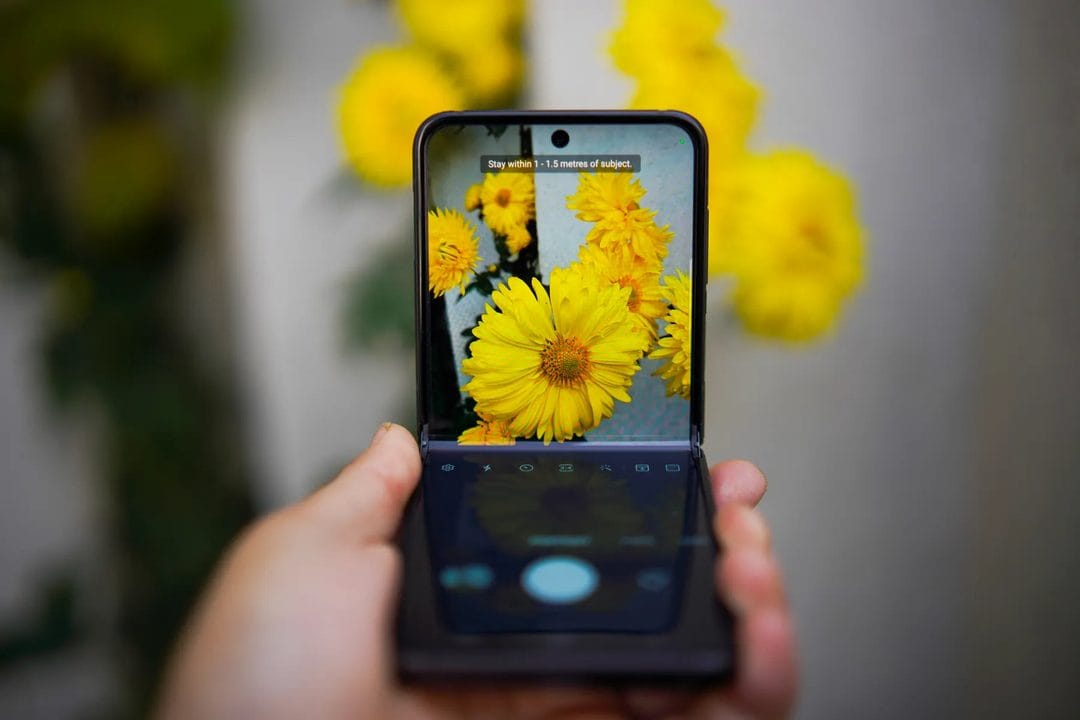
The hardware itself — a 48MP Fusion Main with a built-in 2x optical-quality telephoto and a 48MP Fusion Ultra Wide — is the same sensor stack Apple put in the iPhone 18 Pro. What's new is what the fold lets you do with it. Smart Take uses on-device AI to watch a scene in real time and fire the shutter automatically when everyone in frame is actually posing, which solves the specific annoyance of racing a self-timer back into a group photo. Duo Preview mirrors the live shot onto the outer display so your subject can check their own framing before you press anything. And if you're shooting a portrait, you can flip the phone around and use the sharper rear cameras for a selfie, previewing the result on the outer screen instead of guessing.
None of this replaces a dedicated camera, and Apple isn't pretending otherwise — the photo quality ceiling here is identical to the iPhone 18 Pro's, not higher. What you're buying with the fold is workflow, not resolution.
Titanium, Ceramic Shield 2, and the Hinge Nobody Trusts Yet
Apple built the frame from grade 5 titanium with a mirror-polished finish, backed it with Ceramic Shield on the rear and an upgraded Ceramic Shield 2 up front that the company rates at 3x better scratch resistance than the previous generation. The whole thing carries an IP68 rating for dust and water, which folding phones from Samsung and Google have offered for a couple of generations now, so this is Apple catching up rather than leading.
The hinge is the part worth watching. It's built from more than 100 components and is engineered to support the display's center rather than leave a gap, which is the single biggest complaint people have had about earlier folding phones from every manufacturer. Apple's durability claims are always tested in a lab before a phone reaches customers, and this is the company's first attempt at a mechanism this complex — it's worth waiting for six months of real-world drop tests and hinge-wear reports before trusting it the way you'd trust a slab iPhone.
Pricing, Storage, and the Accessories That Add Up Fast
The Duo starts at $1,999 for 256GB, with 512GB, 1TB, and 2TB options above that — Apple hasn't published exact pricing for the larger tiers yet, but expect the usual $200 jump per step based on how the iPhone 18 Pro line is priced. Apple's own financing through Klarna brings it down to $83.29 a month over 24 months, or as low as $57.99 a month if you qualify for the best lease terms. Add the $79 iPhone Duo Case or the $129 Duo Folio with its integrated kickstand, and you're realistically looking at a $2,100–$2,150 out-the-door price before tax.
Compare that to the iPhone 18 Pro, which starts at $1,199, or the iPhone 18 Pro Max at $1,299 — both up for preorder September 12 and shipping September 18, a full five weeks before the Duo reaches anyone's hands. Both come in four colors, including a new burgundy option, and both get the same A20 Pro chip, the same 48MP Fusion Ultra Wide camera, and most of the camera software tricks minus the fold-specific ones.
Who Should Actually Buy This
Buy the iPhone Duo if you regularly do two things on your phone at once — reading a PDF while replying to a colleague in Slack, comparing prices across two Safari windows, or actually using Split View the way Apple demoed it on stage. That's a real, specific use case the Pro Max can't touch, since a folded 7.6-inch canvas genuinely changes how much you can see at once compared to any slab phone Apple has ever made.
Skip it if your priority is photo or video quality, since the camera hardware is identical to the Pro line and $700–$800 cheaper there. Skip it too if you're rough on phones — a first-generation hinge from a company with zero folding-phone manufacturing history is not where you want to find out about long-term reliability the hard way. And if eSIM-only worries you because you travel through regions where physical SIMs are still easier to get on the ground, know that the Duo has no SIM tray at all; the iPhone 18 Pro at least gives you that option in some markets.
The honest read: this is Apple's best first-generation product in years, and also clearly a first generation. Buy the iPhone 18 Pro Max now if you want the safe, proven choice at a lower price, since it ships five weeks earlier and carries none of the fold's unresolved questions. Buy the Duo if the two-screen workflow is worth $700 and some hinge-durability risk to you — and if you can wait until October 23 to find out for yourself. Storage capacity is the other variable worth thinking through before you order, because 256GB fills up fast once you're shooting 4K120 Dolby Vision clips on that bigger screen, and Apple hasn't confirmed exact pricing on the 512GB, 1TB, or 2TB tiers yet. Whichever way this goes, the fact that Apple finally showed up to the folding-phone category — a full seven years after Samsung's first Galaxy Fold — says as much about where phones are headed next as anything printed on the spec sheet.